
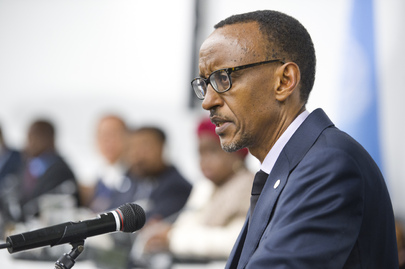
High-level Event on Democratic Republic of Congo
UN Photo/Eskinder Debebe
Lately, Rwanda has received considerable media attention for its role in the M23 crisis in eastern Democratic Republic of Congo (DRC). After two reports by the UN Group of Experts on the DRC tied Rwanda to the armed group, the international community began to take action. This past July, after the release of the first UN report, the U.S., Germany, and The Netherlands all cut portions of their aid to Rwanda. Rwanda's biggest donor, the UK announced on the 30th of November that it finds the available evidence against Rwanda and its role in the DRC "credible and compelling" and subsequently cut £21mof aid intended to be disbursed this month.
These recent developments represent part of an emergent trend in which Rwanda is criticized for its role in neighboring countries but congratulated for its domestic progress. Rwanda is consistently praised in the media for its leaps in development—particularly related to free education, the number of women in parliament, its national health care plan,Mutuelle de Sante, and its growth in gross domestic product (GDP). Critical voices, such as Timothy Longman's op-ed piecefrom June 2012, have been few and far between. However, on Sunday, 24th of November, this silence was interrupted when President Kagame's former advisor David Himbara, who fled the country in 2010, issued a statement claiming that "Britain is not funding Rwanda. It is funding a dictator." This remark comes at a time when foreign aid is being withdrawn in response to Rwanda's role in fueling the violence in DRC, and not because of Kagame's repressive domestic policies. Viewed in this context, Himbara's statement begs the question, is Rwanda's predatory behavior outside its borders connected to its increasingly authoritarian domestic policies? It also raises the worrisome question how aid money can contribute to the suppression of the Rwandan people and help make possible Kagame's military involvement outside of Rwanda.
A closer look at the processes of democratization and decentralization in Rwanda sheds light on the façade-like nature of development programs in Rwanda. Despite heavy funding for a decentralization reform program that began in 2000, Rwanda is still considered "not free" by the international democracy-monitoring agency Freedom House International. The decentralized governance structure and government development programs have failed to genuinely empower Rwandan citizens. Rather, the highly target-driven development agenda squeezes out room for local voices and increases the reach of the central state into the village, while the mechanisms of decentralized governance are employed to effectively control poor and voiceless rural citizens.
While in certain rural areas there is an increase in the number of schools, health clinics, and local government offices, access to these services seem to come at the high price of subtle repression and disenfranchisement. Furthermore, there are no other political parties other than the governing Rwandan Patriotic Front (RPF), so political representation is limited. While other parties technically exist, they have no presence in the rural areas, and reports of abuse, intimidation, and vote influencing have been a major concern in both the 2008 parliamentary and 2010 presidential elections.
Given this de facto one-party scenario, local officials (always RPF members), under severe pressure to meet national development targets, are vastly more accountable to the central state than they are to the people they represent. Their main objective is to reach development targets, agreed upon at national level, and to ensure that the centrally-sanctioned policies and concepts are understood in the village—that all Rwandans are one, that speaking about ethnicity is an act of "divisionism," and that if you do not send your kids to school you will be fined. People do participate in local governance meetings.However, most often this "participation" simply means attendance of local political meetings to listen to leaders "sensitize" them on the central state's priorities.[1]
Even beyond the formal state apparatus, it is well recorded that civil liberties and empowerment in Rwanda are constrained by the social order designed to create a "new Rwanda". Freedom of the press and NGO activity are two areas where the state has tight and increasing control. Furthermore, opportunities for protest or public action simply do not exist and mobilization against the state is almost always deemed an act of divisionism. Democracy in Rwanda, despite its outwardly progressive appearance, is internally deficient.
Despite much evidence to support the case that Rwanda is indeed a dictatorship, or at least veering in this direction, over the recent years donors have chosen to turn a blind eye on the country and its people, forgoing expression of their concerns regarding the internal politics of Rwanda, focusing instead on the country's ability to reach its development targets. Outspoken reactions, however, are common when reports suggest that Rwanda breaches the sovereignty of the DRC. But outraged donors and the international community fail to draw connections between the domestic policies of the country and its foreign meddling. If appropriate domestic and international policy is to be built to address Rwanda's ills, the international community and donors need to stop paying lip service to Rwanda's development achievements, at the expense of condoning the oppression of her people. Condemning Rwanda's foreign policy, while uncritically commending its domestic achievements, and ignoring their connection, only makes for confused and poor policy.
[1] Many studies into decentralization and public participation in Rwanda have found that these interactions are very one-sided with information flowing from the top-down and with very limited input from Rwandan citizens. For more, see Purdeková, A. (2011) 'Even if I am not here, there are so many eyes': surveillance and state reach in Rwanda',Journal of Modern African Studies, 49, 3 (2011): 475-497 Cambridge University Press and Ingelaere, B. (2011) 'The Ruler's Drum and the People's Shout: Accountability and Representation on Rwanda's Hills'. In: Straus, S. and Waldorf, L. eds. Remaking Rwanda: State building and human rights after mass violence. Madison: University of Wisconsin Press.
Comments
Post a Comment