
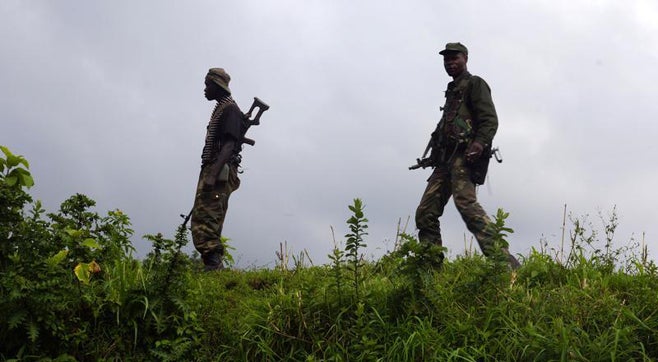
- Congolese soldiers advance against the M23 rebels near the Rumangabo military base in Runyoni.© 2013 Reuters
The M23 admitted defeat today, bringing an apparent end to the Rwandan-backed armed group's devastating attacks on civilians in the Democratic Republic of Congo. That's a big step forward, but the work to account for the crimes committed by all sides in this complicated conflict has only begun.
The M23's sudden defeat is partly due to the Congolese army's military operations and the crucial support provided by the United Nations peacekeeping force, MONUSCO, and its new African-led Intervention Brigade.
But the key may have been mounting international pressure on Rwanda to stop supporting the M23. After aid suspensions to Rwanda by key donors in 2012 and 2013, public denunciations from its close allies, and phone calls to Rwandan President Paul Kagame from United States Secretary of State John Kerry and United Kingdom Foreign Secretary William Hague when the latest round of fighting began in late October, the Rwandan government may have concluded that its support to the M23 had become too damaging to its public image. In the recent fighting, the M23 rebels did not get the military support from Rwanda that they had depended on in earlier operations.
For the past 19 months, the rebels terrorized civilians: killing and raping them, forcibly recruiting children as soldiers, and targeting anyone who dared to speak out against the abuses. Just yesterday, the M23 shelled the towns of Bunagana and Chengerero, killing at least 15 civilians and wounding many others. Last night, they were pushed out of their two remaining positions, and this morning announced an endto their rebellion.
While many in Congo are likely to celebrate the defeat of the M23, numerous challenges remain. Eastern Congo has been beleaguered by abuses by other armed groups, as well as by theCongolese army itself, which have also been responsible for killings, rapes, and other human rights violations.
Going forward, the Congolese government should focus on the following three priorities:
· Arrest M23 leaders responsible for war crimes, crimes against humanity, and other serious human rights abuses and bring them to justice in fair, credible trials;
· Issue explicit orders to all members of the security forces not to carry out revenge attacks or other abuses against members of the Tutsi ethnic group or suspected M23 collaborators. Those implicated in such acts should be promptly brought to justice; and
· Together with MONUSCO, address the threat posed byother abusive armed groups, including the Democratic Forces for the Liberation of Rwanda (FDLR), the Nduma Defense of Congo (NDC) led by Ntabo Ntaberi Sheka, the Raia Mutomboki, and a number of Congolese Hutu militia groups often referred to as Nyatura. As part of these efforts, urgently implement a new Disarmament, Demobilization, and Reintegration program that provides alternative employment opportunities for ex-combatants and ensure that rebel leaders responsible for serious human rights abuses are arrested and brought to justice.
The Congolese government, with UN and diplomatic support, has shown a strong commitment to addressing the threat posed by the M23 in a way that avoids repeating past mistakes of rewarding war criminals with high-ranking military posts and promoting impunity. It should demonstrate the same resolve when addressing abuses by other armed groups, as well as members of its own security forces.
 FACEBOOK
 LINKEDIN
 EMAIL
EMAIL REDDIT
 STUMBLEUPON
 TWITTER
 GOOGLE +
Comments
Post a Comment