Rwanda and the ICC: Playing Politics with Justice – By Stephen A. Lamony
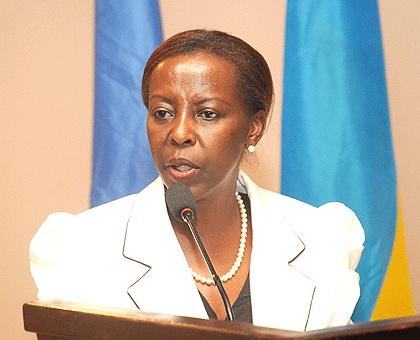
Rwandan Foreign Minister Louise Mushikiwabo has called the ICC "a political court" and said that Rwanda has "never believed in its jurisdiction".
Rwanda's stated position on the International Criminal Court (ICC) is highly critical. Rwandan Foreign Minister Louise Mushikiwabo called the ICC "a political court" and said that Rwanda has "never believed in its jurisdiction". In 2008, President Kagame called the ICC a "fraudulent institution" that is "made for Africans and poor countries" who did not realize what they were signing up for when they ratified the Rome Statute. However, the clear-cut stance expressed in these statements seems to be blurred by Rwanda's recent decision to facilitate the transfer of indicted militia leader Bosco Ntaganda to The Hague in March of this year.
This is not to say that Rwanda's rhetoric has changed: during a Security Council debate on conflict prevention in Africa in April, Rwanda blocked the inclusion of any positive language for the work of the ICC in a presidential statement. In May, President Kagame said that Rwanda "cannot support an ICC that condemns crimes committed by some and not others or imposes itself on democratic processes or the will of sovereign people". The apparent contradiction between Rwanda's words and actions can only begin to be understood by examining its relationship with the ICC within its political and historic context.
Rwanda has not always so loudly opposed the idea of a permanent international criminal court. During the Rome Conference that created the ICC, it explicitly supported the creation of such an institution, and even favored giving it some powers that the ICC does not possess, such as the authority to use the death penalty for the most heinous crimes. Neither did it speak negatively of the International Criminal Tribunal for Rwanda (ICTR), but rather pointed out that an international criminal court "would not obviate the need for ad hoc tribunals, which should retain their jurisdictional competence and continue to receive support".
However, Rwanda chose not to sign the Rome Statute as it was finally negotiated, and has since become one of the ICC's harshest critics. It has also employed more negative language for the ICTR. Former Justice Minister Tharcisse Karugarama said his country felt "betrayed" by the ICTR and current Justice Minister Johnston Busingye claimed that the ICTR had fallen short of its potential, while the community-based system of "gacaca courts" have been a big success.
In theory, Rwanda's official position can be summed up by saying that it supports international justice, but simply thinks it has not been done well. In an address given in Addis Ababa in May of this year, President Kagame said that an international justice system "needs to be free of political interference and uphold the principle of sovereign equality of states, an objective Rwanda believes the ICC has completely failed to accomplish". Therefore, Rwanda claims to be an advocate for ending impunity but critical of the alleged political maneuvering behind the ICC.
In reality, however, Rwanda's own actions and relationship with the ICC are also very much motivated by political interests. Many have argued that the real reason Rwanda does not want to sign the Rome Statute is so its military commanders and political leaders cannot be held accountable to the ICC for their involvement in supporting rebel groups in neighboring Democratic Republic of the Congo (DRC). These fears are not totally unfounded. In August 2012, opposition groups from Rwanda and the DRC asked the ICC to investigate Paul Kagame for alleged war crimes in eastern Congo. However, up until recently, on a broader scale, Kagame has had a positive international image as the leader who got Rwanda back on its feet after the 1994 genocide, and has been regarded as a key Western ally in the region.
International opinion started to turn recently after the M23 rebel militia took control of Goma in eastern DRC and the United Nations published a report stating that Rwanda had created the group and commands it. Some of Rwanda's European donors cut back on their aid, and the US warned Rwanda against continued interference in the DRC.
In the following months, the M23 militia experienced severe fragmentation of its leadership: violence broke out between camps led by rivals Bosco Ntaganda and Sultani Makenga. There were reports that Makenga was in negotiations with the Congolese government for a peace deal, and Rwanda allegedly pressured M23 officers to side with Makenga, seeing an opportunity to end a costly war by reintegrating him and his men into the regular army. After suffering a defeat at the hands of Makenga's men and feeling that his life was in danger, Ntaganda surrendered himself to the US embassy in Kigali.
Given its openly critical position towards the ICC, it came as a surprise when Rwanda agreed to facilitate Ntaganda's transfer to The Hague. Since then, however, many have questioned Rwanda's claim that it had no prior knowledge of Ntaganda's intentions to give himself up. Rather, it has been argued that Rwanda – with the support of the US – in fact carefully orchestrated the surrender. A Rwandese newspaper claims that Ntaganda was coached on how he should defend himself at the Court, with strict instructions not to sell out Kagame but rather act as "Kagame's ambassador at the ICC".
Should these allegations be true, it is not difficult to imagine Rwanda's motivations. With international pressure rising, being seen as cooperating with the ICC to put a leader of the M23 militia on trial could be a way to defuse accusations of Rwanda's support for the group and portray Kagame as an advocate for justice. By making a deal with Ntaganda and reassuring him that he will have all the support he needs to be exonerated of the charges, Ntaganda would be less likely to reveal the extent of Kagame's and Rwanda's involvement in the DRC. As a demonstration of cooperation, it could also be taken as a sign of good faith in order to reassure its foreign allies so that aid will return to previous levels. Furthermore, with the recent signing of the Peace, Security and Cooperation Framework for the Democratic Republic of the Congo and the Region in February, Western powers are more likely to be interested in ending the war and promoting stability – both of which require Rwanda's cooperation – rather than determined to prove that Kagame should be tried at the ICC.
In this context, the facilitation of Ntaganda's surrender and transfer by Rwanda should not be taken as a sign of a shifting ideological position on the ICC – which remains oppositional – but rather as part of a more complex political strategy.
Stephen Lamony is a Senior Adviser, AU, and UN & Africa Situations at the Coalition for the International Criminal Court.
Comments
Post a Comment